

How Listening and Questioning Shape Behaviour, Collaboration, and Influence
By Gerry Murray
Workplaces run on conversations — conversations about performance, expectations, priorities, values, decisions, and the countless moments where people need to align, clarify, negotiate, or resolve tension. Yet ask anyone in HR, leadership, or people development, and they will tell you the same thing:
Most difficult conversations do not fail because people disagree.
They fail because people are talking from different maps of the world — and don’t realise it.
When pressure rises, when stakes are high, or when emotions are involved, people tend to defend their interpretation of events. They double down on their certainty. They protect their perspective. That’s when conversations harden and collaboration breaks down.
But it doesn’t have to be this way!
When leaders understand how listening and questioning shape human behaviour, conversations become one of the most powerful tools for influence, conflict reduction, and performance.
This article explores why listening and questioning matter far more than most people realise — and how you can use both to transform the way people think, feel, and act.
Conversations Shape Behaviour
Every interaction involves two things:
- What is said
- What is meant
The challenge is that these are rarely identical.
Human beings interpret the world through internal “maps”—models of experience shaped by values, beliefs, memories, fears, assumptions, and meaning-making.
We respond to our map of a situation, not the situation itself.
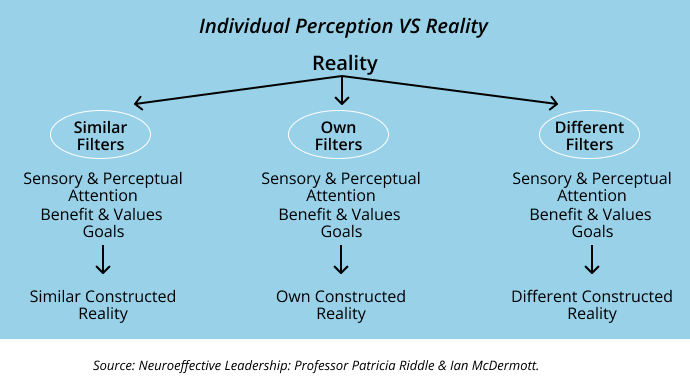
This is why the same event can be interpreted in different ways by different people. And it’s why two intelligent, well-intentioned colleagues can look at the same piece of data, decision, or behaviour and draw entirely different conclusions.
If you want to influence another person's behaviour, you must first understand their map.
Listening reveals the map. Questioning expands it. And when a person’s map expands, new choices emerge.
This is the foundation of leadership influence.
Why Misunderstanding and Conflict Arise
Alfred Korzybski’s famous principle — “the map is not the territory” — has profound implications for the workplace.
The map represents a person’s internal representation of reality. The territory represents reality itself.
No person ever sees the full territory. Everyone navigates through a partial, selective, and simplified map.
Conflict is what happens when:
- two different maps collide
- each person assumes their map is the territory
- one person believes their map is the correct one
- assumptions and interpretations go unexamined
This is the real source of most workplace tension — not personality, not disagreement, not resistance, but map collision.
The purpose of a high-quality conversation is not to decide which map is more accurate.
It is to understand how each map was formed — and to help both sides expand their maps enough to create alignment.
The fastest way to do this is through listening and questioning.
The Role of Listening: The Foundation of Influence
People often think they are listening when they are actually preparing their response.
They think they are paying attention when they are evaluating what they agree or disagree with.
But influence begins long before you speak. It begins with how well you listen.
Listening for meaning means listening behind the words — for the values, needs, expectations, assumptions, and emotions driving someone’s experience.
This kind of listening signals:
- presence
- care
- psychological safety
- respect
- emotional openness
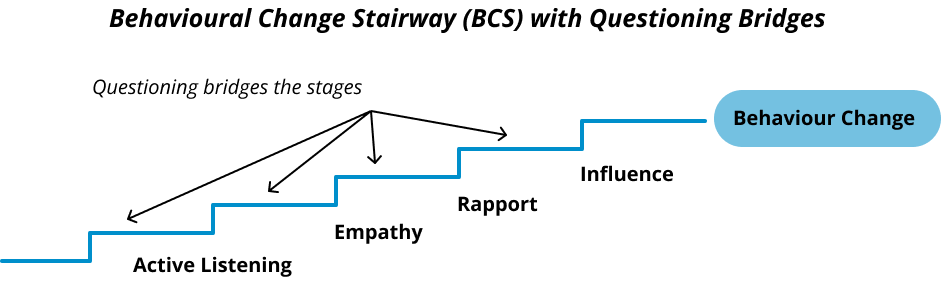
It also activates the first two stages of the Behavioural Change Stairway: Active Listening → Empathy
When someone feels understood, they stop defending their map and start revealing more of it.
Defensiveness drops. Rapport forms. Trust increases. And trust is the gateway to influence.
Why Questions Matter More Than Most Leaders Realise
If listening reveals meaning, questions shape attention. Every question you ask directs the other person’s thinking. It points their awareness toward:
- values
- assumptions
- gaps
- inconsistencies
- options
- consequences
- new perspectives
In cognitive psychology, this is called attentional cueing.
In linguistic theory, it triggers transderivational search — an internal search for meaning that goes beyond the surface level.
In plain language: A question shines a spotlight.
The mind will follow wherever the spotlight is pointed. This may be somewhere the other person never thought of looking.
This is why questions are so powerful in coaching, influencing, negotiation, conflict resolution, behavioural change, and performance management. Questions create movement. Statements rarely do. 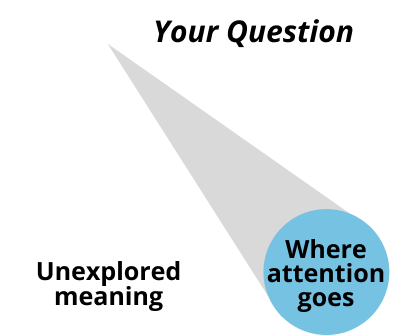
Why “Why?” Is Not Always the Best Opening Question
“Why?” is important. It uncovers motivation and meaning. But used too early, it often triggers defensiveness.
Better first questions include:
- “What’s important to you about this?”
- “What concerns you the most here?”
- “How did you arrive at that view?”
These questions open the person’s map without challenging it. Once you understand their map, then you can explore the “why” safely.
How Questions Create Influence (BCS + Conversation Compass)
Listening and questioning work because they move people through the Behavioural Change Stairway — the process by which conversations shift behaviour.
- Active Listening → Empathy (Listening reveals meaning. Questions clarify and deepen it.)
- Empathy → Rapport (Questions such as: “What matters most to you here?” create emotional connection.)
- Rapport → Influence (Once rapport exists, you can ask questions like: “What options do you see?” “What would be a useful next step?” Suddenly, the conversation opens.)
- Influence → Behaviour Change (Behaviour change does not happen by pressure. It happens when people gain new choices — and those choices come from expanded maps.)
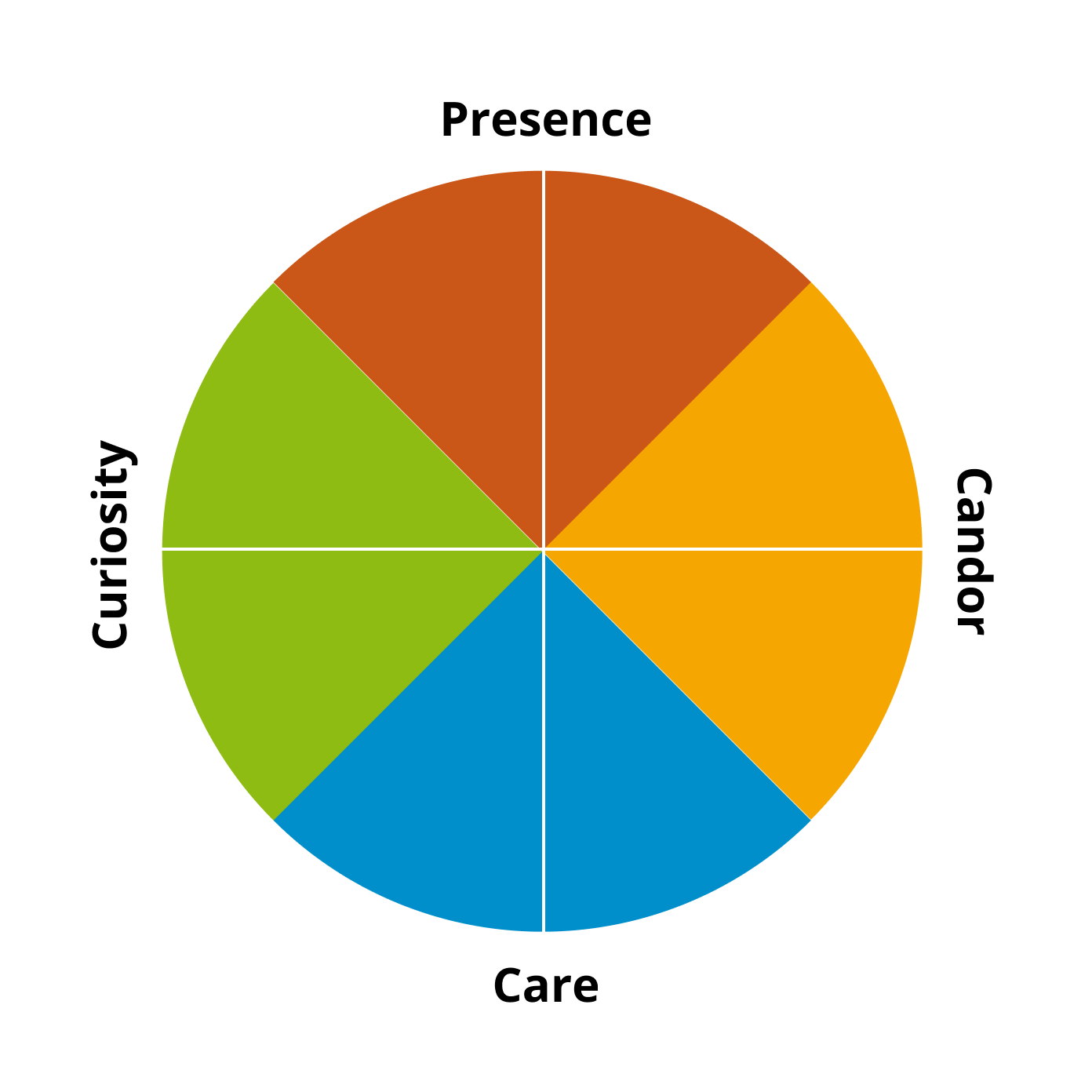
This is supported by Wide Circle's Conversation Compass (CC): Presence + Care + Curiosity + Candour.
You listen with presence. You show care. You ask questions with curiosity.
And when the moment is right, you add candour — clear, direct, meaningful questions that move the conversation forward.
When all four are in balance, the quality of the conversation shifts dramatically.
Five High-Impact Questions for Moments of Tension
Here are five practical questions you can use immediately in conversations where emotions, ambiguity, or disagreement are present:
- “What’s most important to you in this?” Reveals values. Reduces defensiveness.
- “What problem are we really trying to solve?” Creates alignment.
- “How did we get here?” Recovers sequence, assumptions, and process — without blame.
- “What would a good outcome look, sound or feel like for you?” Reframes the conversation around solutions with sensory-based evidence.
- “Where should we focus first?” Creates movement and clarity.
These questions work because they expand the map without threatening it. They turn tension into shared exploration. They turn disagreement into discovery. They turn conflict into collaboration.
Closing Insight: Skilled Leaders Expand Maps
Leadership is less about directing behaviour and more about expanding perspective. When you listen deeply, people feel understood. When you ask skilful questions, people think more clearly. When people think more clearly, they choose better behaviours. And when behaviour changes, collaboration improves.
Great leaders use conversations not to control people, but to help them see more.
Because when the map expands, everything becomes possible.
Further Resources in the Talent Lab Community
To deepen these skills and apply them in real workplace situations, you’ll find:
- recorded Live Labs on collaboration, influence, and difficult conversations
- practical tools such as the Conversation Compass framework
- downloadable worksheets on listening and questioning
- selected Leading People podcast episodes exploring leadership behaviour
- early access to new models and tools as they are developed
These resources are designed to help you continue building the conversational capability and capacity that drives better leadership, better collaboration, and better organisational outcomes.
Explore the Talent Lab Community: Click here